Chinese Cabbage Formalin News: How True Is It, and How to Wash Vegetables Safely with Strong Kangen Water pH11.5
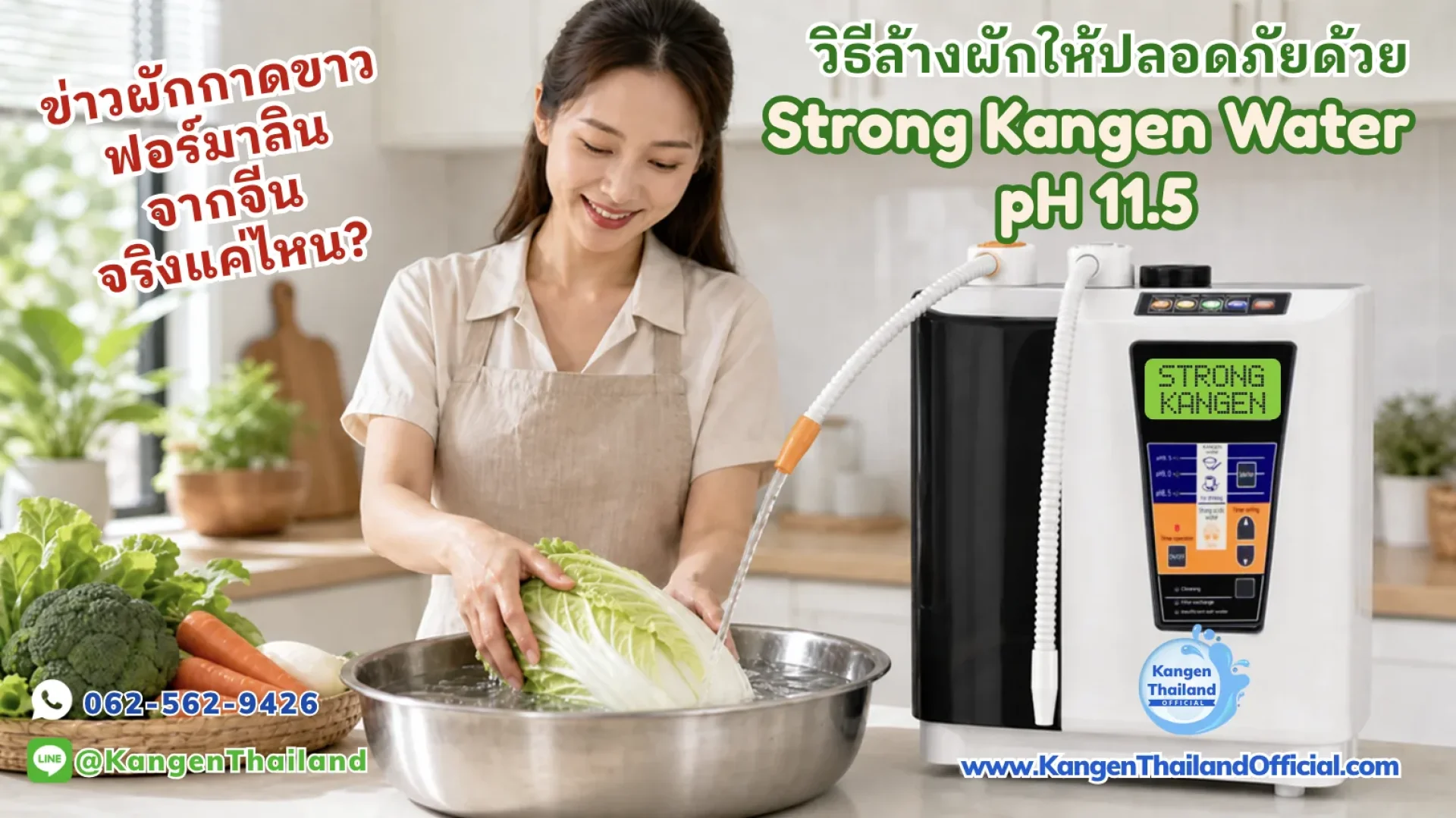
Chinese Cabbage Formalin News: How True Is It, and How to Wash Vegetables Safely with Strong Kangen Water pH11.5
In late August 2026, a shocking food safety story spread across social media: a video from a Chinese environmental blogger revealed napa (Chinese) cabbage being treated with formalin to keep it looking fresh before sale. The news has left many Thai consumers wondering how safe napa cabbage and other vegetables imported from China really are. This article walks through where the story came from, checks the facts against official test results, and explains how to choose and wash vegetables safely - including a science-backed option: Strong Kangen Water pH11.5, which has published research behind its ability to help remove chemical residue from produce.
Where the News Came From: Did China Really Use Formalin on Vegetables?
The story began with a Chinese environmental blogger known as "Qige," who posted a video on Douyin showing napa cabbage being dipped in a formalin solution. The incident took place in Tuanke Township, Kangbao County, Zhangjiakou City, Hebei Province. Chinese authorities confirmed the video was genuine and have pursued legal action against the individuals involved.
The reason for using formalin was to inhibit bacterial and fungal growth, keeping the cabbage looking fresh for an extra 2-3 days during transport and sale. This practice is illegal even under China's own food safety laws, and state media outlet People's Daily condemned it as "short-term-profit-driven behavior that disregards consumers' lives and health."
Latest test results: Thailand's Food and Drug Administration (FDA) sampled 42 vegetable samples on August 25, 2026, from 3 border checkpoints (22 samples) and 2 wholesale markets (20 samples, split between 11 imported and 9 domestic). No formalin contamination was found in any sample. Similarly, South Korea's Ministry of Food and Drug Safety tested 8 lots of napa cabbage imported from China on August 26, 2026, and also found no formaldehyde.
How Much Vegetable Does Thailand Import from China?
A great deal. In 2024, Thailand imported over 1.12 million tons of vegetables in total, with China accounting for a large share due to significantly lower production costs. Vendors at Talaad Thai, one of the country's largest wholesale vegetable markets, report that more than 50% of the vegetables sold there are imported from China. Napa cabbage is among the most heavily imported vegetables, since it is noticeably cheaper than Thai-grown cabbage. Given this volume, it is no surprise that a food safety story out of China directly shakes Thai consumer confidence.
How Concerning Is Formalin in Napa Cabbage?
Even though the latest tests from Thailand and South Korea found no contamination, that does not mean consumers should assume everything is fine. Sample sizes in these spot checks are limited, and the practice has so far only been confirmed in one area of China - it is unknown whether it has spread elsewhere. Formalin (a formaldehyde solution) is strictly banned in food under Thai law, and the World Health Organization classifies formaldehyde as a Group 1 carcinogen (carcinogenic to humans) under conditions of high, sustained exposure. This is a reason to stay cautious in advance, rather than wait for confirmed contamination before taking precautions.
Health effects of eating formalin-contaminated vegetables: High exposure to formaldehyde can cause irritation of the mouth, throat, and digestive tract, along with nausea, vomiting, and diarrhea. Long-term accumulated exposure carries a risk of chronic toxic effects on various body systems. This information is general preventive knowledge, not medical advice - if you suspect symptoms from toxic exposure, please consult a doctor directly.
How to Choose Vegetables Safely
General Ways to Wash Vegetables and Reduce Chemical Residue
Thailand's FDA recommends two simple washing methods you can do at home:
1. Rinse under running water - run water over the vegetable while separating and rinsing the leaves for at least 30 seconds to 2 minutes. This helps reduce surface dirt and some chemical residue.
2. Soak in a baking soda solution - mix 1 teaspoon of baking soda per 4 liters of water, soak the vegetables for 15 minutes, then rinse again with clean water before cooking. This method removes acid-based residues more effectively than plain water alone.
Why Strong Kangen Water pH11.5 Is Well Suited to Washing Vegetables
Beyond the basic washing methods above, there is another option worth knowing about, backed by published scientific research: Alkaline Electrolyzed Water. Strong Kangen Water pH11.5, produced by Kangen Water ionizer machines, falls into this same category, with a pH close to the alkaline electrolyzed water used in several academic studies.
According to the international academic reference Electrolyzed Water in Food: Fundamentals and Applications (edited by Tian Ding et al., published by Springer Nature Singapore and Zhejiang University Press, 2019), in the chapter on pesticide removal using electrolyzed water, electrolyzed water is generally divided into two main types based on the electrode it is generated at: Acidic Electrolyzed Water, known for its disinfecting/sanitizing strength, and Alkaline Electrolyzed Water, which typically has a pH of around 11-12 and is specifically known for removing oily residues and pesticide residue, rather than for disinfection.
Studies cited in that book provide useful data. Han et al. (2017) tested alkaline electrolyzed water at pH 12.2 for removing 6 pesticide residues from cowpea, finding it outperformed plain tap water, a 5% salt solution, a 5% sodium carbonate solution, and a 5% vinegar solution - and that removal effectiveness increased with longer soaking time. Separately, Hao et al. (2011) found that alkaline electrolyzed water at pH 11.6 reduced pesticide residues on fresh vegetables such as spinach and cabbage by 46-86%, without any loss of vitamin C in the produce.
The chemistry behind it: The high alkalinity of Strong Kangen Water pH11.5 helps break down oil-based residues - a common property of many pesticides - making them easier to rinse off the surface of vegetables with clean water afterward. This is unlike plain water, which typically cannot effectively rinse away oil-based residues. That said, alkaline electrolyzed water is not particularly strong at disinfection compared to acidic electrolyzed water, so it is best thought of as a "chemical residue removal" step rather than a "disinfection" step.
Step-by-Step: Washing Vegetables with Strong Kangen Water pH11.5
Note: always rinse vegetables with clean water after soaking in Strong Kangen Water, since it is a strongly alkaline water intended specifically for cleaning purposes - it is not drinking water, and should never be used in cooking without rinsing it off first.
Frequently Asked Questions
Is napa cabbage from China currently sold in Thailand safe?
Based on test results from Thailand's FDA (August 25, 2026) and South Korea's Ministry of Food and Drug Safety (August 26, 2026), no formalin contamination has been found in the samples tested so far. However, since these are limited spot checks, consumers should still buy from trusted sources and wash vegetables thoroughly before eating, for maximum safety.
Can Strong Kangen Water pH11.5 kill germs on vegetables?
According to research compiled in Electrolyzed Water in Food, alkaline electrolyzed water is known primarily for removing oily residue and pesticide residue, rather than for disinfection. If additional bacterial disinfection is desired, combine this with thorough rinsing in clean water and cooking the food fully before eating.
How long should vegetables soak in Kangen Water for it to be effective?
The research cited in this article shows that residue removal effectiveness increases with soaking time. A soak of 20-25 minutes, combined with gentle rubbing or brushing of the surface, is generally recommended for best results.
Summary
The Chinese cabbage formalin story is a real incident that occurred in one part of China. While the latest tests from Thailand and South Korea have found no contamination, given the sheer volume of vegetables Thailand imports from China, consumers should still take precautions: buy from trusted sources, and always wash vegetables thoroughly before eating - whether using basic methods like rinsing under running water or soaking in baking soda, or using Strong Kangen Water pH11.5, which has scientific research showing that alkaline electrolyzed water in a similar pH range helps remove pesticide residue from vegetables more effectively than plain water. For more information about Kangen Water ionizer machines, contact Kangen Thailand Official, an authorized distributor, today.